


7 Signs Your Convertible Roof Needs Replacement
A convertible roof rarely fails all at once. More often, it starts with a damp seat after rain, a new whistle at motorway speed, or fabric that no longer sits as tightly as it should. If you are noticing these changes, the signs your convertible roof needs replacement are usually already there – and catching them early can save you from more expensive interior and trim damage.
For owners in Singapore, the roof takes a steady beating from heat, humidity, UV exposure and sudden downpours. That combination can age fabric, shrink seals, weaken stitching and stress the frame over time. Some issues can still be repaired, but there is a point where patching stops being cost-effective and a full replacement becomes the cleaner, longer-lasting answer.
Signs your convertible roof needs replacement
1. Persistent leaks are showing up in more than one place
An occasional drip does not always mean the whole roof has failed. Sometimes the problem is a blocked drainage channel, a tired seal, or a localised split. But if water is entering from several areas, or keeps coming back after repairs, the roof system is usually telling you something more serious.
This matters because water rarely stays where it lands. It can soak headlining materials, mark trim panels, affect electronics and leave a stale smell inside the cabin. Once moisture gets into the structure beneath the top, the cost of waiting often climbs quickly.
A specialist workshop will normally look at the fabric, seams, seals and frame alignment together. If the material itself has aged and lost integrity, replacing only one small section may not hold for long.
2. The fabric is cracked, frayed, shrunken or going thin
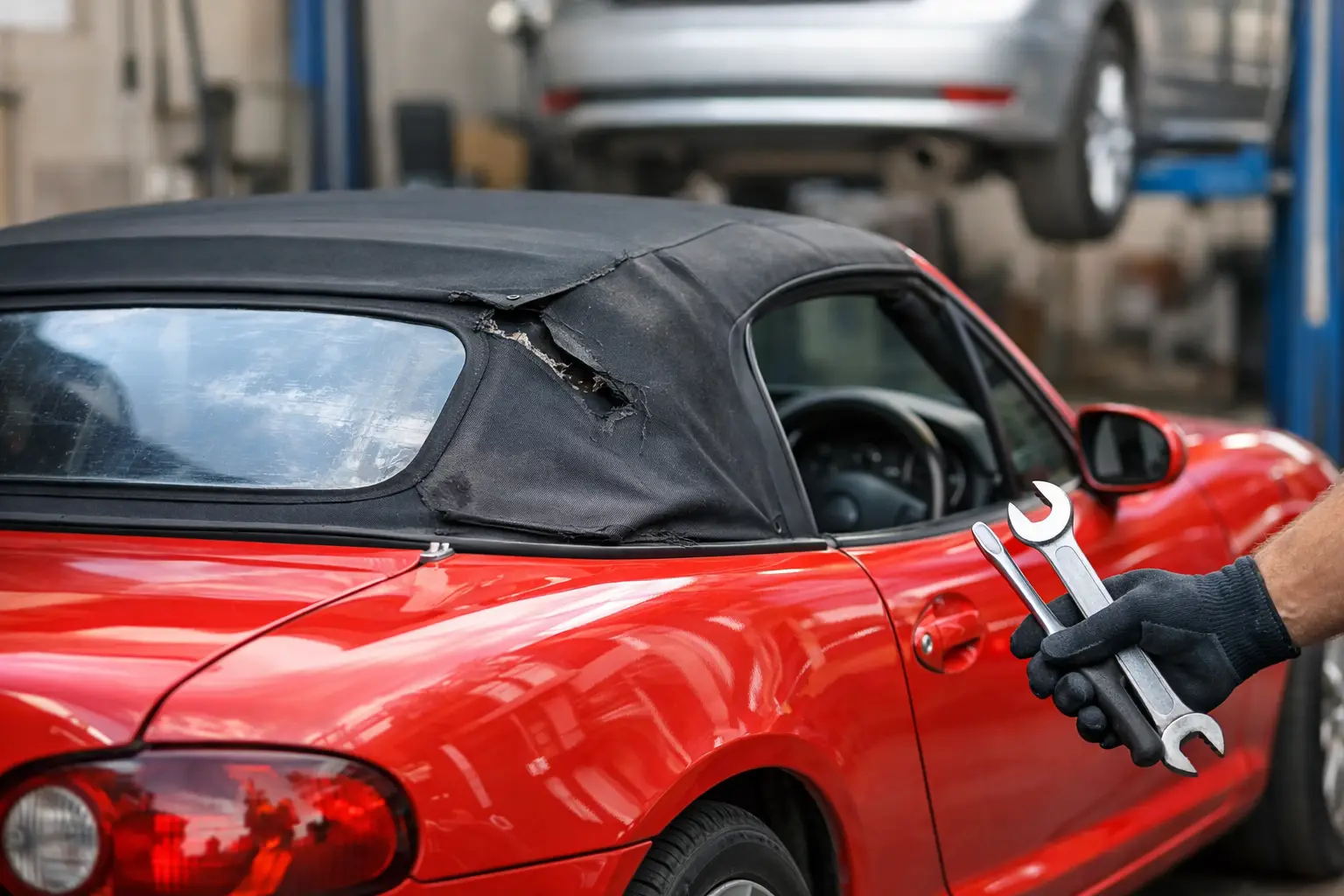
Convertible top material is designed to work hard, but it does not last forever. Sun exposure can dry it out. Repeated folding can stress the same areas again and again. Over time, you may notice the outer layer looking faded, rough, thin at the folds, or visibly frayed around edges and seams.
Shrinkage is another clear warning sign. When the roof starts pulling too tightly at the frame, corners may lift, seals may stop sitting properly, and closing the roof can become more difficult than before. At that stage, the issue is no longer cosmetic.
Small cosmetic wear can sometimes be managed, especially on a cherished car where preserving original parts matters. But if the material has hardened, cracked or distorted, replacement is usually the more disciplined decision.
3. Rear window separation or clouding is getting worse
On many soft tops, the rear window area is one of the first sections to show age. You might see the window pulling away from the surrounding material, adhesive lines failing, or the panel turning cloudy and brittle. In some cases, the window itself may still be intact while the surrounding roof material is no longer stable enough to support it.
This is not just a visibility issue. Once separation starts, water ingress and further tearing often follow. Temporary resealing may buy some time, but if the roof around the window is already weak, it is rarely a long-term fix.
A proper assessment should consider whether the window can be addressed independently or whether the roof has deteriorated too far overall. That distinction matters, because replacing only the visible problem does not help if the rest of the top is close behind.
When repair stops making financial sense
4. Seams and stitching are failing across multiple areas
Stitching failure often appears subtle at first. A few threads loosen, a seam opens slightly, or one section begins to pucker. Left alone, those weak points spread under tension, especially when the roof is opened and closed regularly.
If there is a single failed seam on otherwise healthy material, repair may still be sensible. But if multiple stitched areas are opening up, that usually reflects age across the roof rather than one isolated defect. In workshop terms, you are no longer dealing with one fault. You are dealing with an assembly that is nearing the end of service life.
This is where honest advice matters. Repeated seam repairs can add up without giving the roof a proper reset. For many owners, especially those who care about fit, finish and long-term use, replacement offers better value than chasing one weak point after another.
5. Road noise and wind buffeting have noticeably increased
A well-fitted convertible roof should not feel loose or unsettled at speed. It will never be as insulated as a fixed metal roof, but there is a normal level of cabin refinement and an abnormal one. If wind noise has become louder, buffeting has increased, or the roof starts sounding as though air is getting under it, the fit may have changed.
That can happen when fabric stretches in some places and shrinks in others, when seals flatten, or when the roof no longer tensions properly across the frame. Some of these issues are adjustable. Others are signs that the material itself can no longer sit correctly.
The trade-off here is straightforward. If the frame is healthy and adjustment solves the issue, a replacement may not be necessary yet. But if the top has lost shape, no amount of minor tweaking will make an old roof behave like a properly fitted new one.
6. The roof no longer opens, closes or latches cleanly
Owners often assume a difficult roof operation is purely a mechanical problem. Sometimes it is. Hydraulic, electrical or frame-related faults can absolutely affect movement. But the roof skin also plays a role. If the material has shrunk, stiffened or shifted, it can place extra strain on the mechanism and prevent clean alignment.
Typical signs include needing extra force to latch it, seeing one side sit higher than the other, or noticing that the roof only closes properly after repeated attempts. None of that should be ignored. The longer the mechanism works against a poorly fitting roof, the more likely secondary damage becomes.
A specialist will usually check both structure and covering together, because replacing material on a misaligned frame will not solve the root issue, and adjusting a frame around failed material is equally short-sighted.
The signs your convertible roof needs replacement are not only visual
7. There is a persistent musty smell or hidden interior dampness
Not every failing roof announces itself with an obvious tear. Sometimes the first clue is a smell that does not go away, light condensation inside the glass, or carpet and trim that feel slightly damp after rain. By then, water may already be tracking through channels, padding or hidden edges.
This is especially relevant in Singapore, where humidity can make moisture damage linger. Mould, staining and deterioration of interior materials can follow if the source is not dealt with properly. A convertible owner may focus on the outside fabric while the real damage is building underneath.
If the cabin is repeatedly damp and no single seal repair solves it, a roof replacement may be the more controlled way to stop the cycle.
Why specialist assessment matters
Convertible roofs are not generic trim pieces. The fabric, padding, seals, frame tension and fitting method all affect how the finished roof performs. A low-cost patch can look acceptable for a short while but still leave weak tension, poor water management or premature wear around the repaired section.
That is why a specialist workshop approach makes a difference. The right answer depends on the age of the roof, the condition of the frame, the type of material, and how you use the car. A weekend classic that lives under cover may justify a different path from a daily-driven cabriolet exposed to the weather every day.
At 8 Cushion, this kind of work is handled in-house because fit, finish and accountability matter. When a roof needs replacement, the aim is not just to change the outer skin. It is to restore proper function, weather protection and confidence in the car again.
If your roof is leaking, lifting, getting noisy or simply no longer fitting as it should, do not wait for obvious failure. The earlier you assess it properly, the more options you usually have – and the better chance you have of protecting the rest of the vehicle.
Related posts
Best Materials for Convertible Tops
Choosing the best materials for convertible tops means balancing durability, wea

How to Assess Windscreen Chip Damage
Learn how to assess windscreen chip damage properly, spot repairable chips early
Rear Windscreen Demister Repair: What Matters
Rear windscreen demister repair: practical advice on failed heater lines, durabl