


Windscreen Calibration After Replacement Guide
A replacement windscreen can look perfect and still leave a critical job unfinished. For vehicles fitted with a forward-facing camera, this windscreen calibration after replacement guide explains why the glass, camera position and calibration process must be treated as one disciplined repair – not separate tasks.
Many modern cars use the area behind the rear-view mirror for advanced driver assistance systems, commonly called ADAS. This camera may support lane departure warnings, lane-keeping assistance, automatic emergency braking, adaptive cruise control or traffic-sign recognition. When the windscreen is removed and refitted, even a very small change in the camera’s reference point can affect how those systems interpret the road ahead.
For owners of premium, newer or carefully maintained vehicles, the issue is not simply whether the windscreen is clear. It is whether the vehicle’s safety technology has been returned to the standard intended by the manufacturer.
Why calibration matters after a windscreen replacement
The camera does not see the road in the same way a driver does. It works from precise measurements, angles and known reference points. Its software expects the camera to sit in a particular position behind a correctly fitted windscreen. A replacement may change that relationship through glass specification, camera bracket alignment, vehicle ride height or the way the screen has settled in its aperture.
Without calibration where it is required, the system may give late, early or inconsistent warnings. Lane markings may be recognised incorrectly. A driver-assistance feature may disengage unexpectedly. In some cases, the vehicle will display a warning message and disable a function altogether.
That does not mean every replacement windscreen needs calibration. It depends on the vehicle, its equipment and manufacturer procedure. Older vehicles without a forward-facing ADAS camera generally do not require it. A car with camera-based safety functions often will. The correct answer should come from identifying the vehicle and checking its fitted systems, rather than assuming that all screens or all models are the same.
Windscreen calibration after replacement: what a proper process involves
A careful process begins before the old glass is removed. The workshop should identify the vehicle specification, inspect the existing windscreen and confirm whether the camera, rain sensor, heating elements, heads-up display or other components are fitted. This matters because windscreens that appear similar can have important differences in optical properties, brackets, shading bands and sensor locations.
The replacement glass must be compatible with the vehicle. Price alone is a poor basis for choosing it. A screen may physically fit yet be unsuitable for a camera-equipped model if the camera mounting area, optical quality or specification differs. Where a customer is deciding between options, the workshop should explain the practical implications clearly.
Removal also requires control. Trim, mouldings, dashboard edges, roof lining and paintwork around the aperture should be protected. Adhesive must be cut and prepared correctly, and the new screen must sit accurately in position. A rushed installation can create more than a water leak or wind noise. It can affect the camera’s position and create unnecessary trim damage in a part of the car that is always visible to the owner.
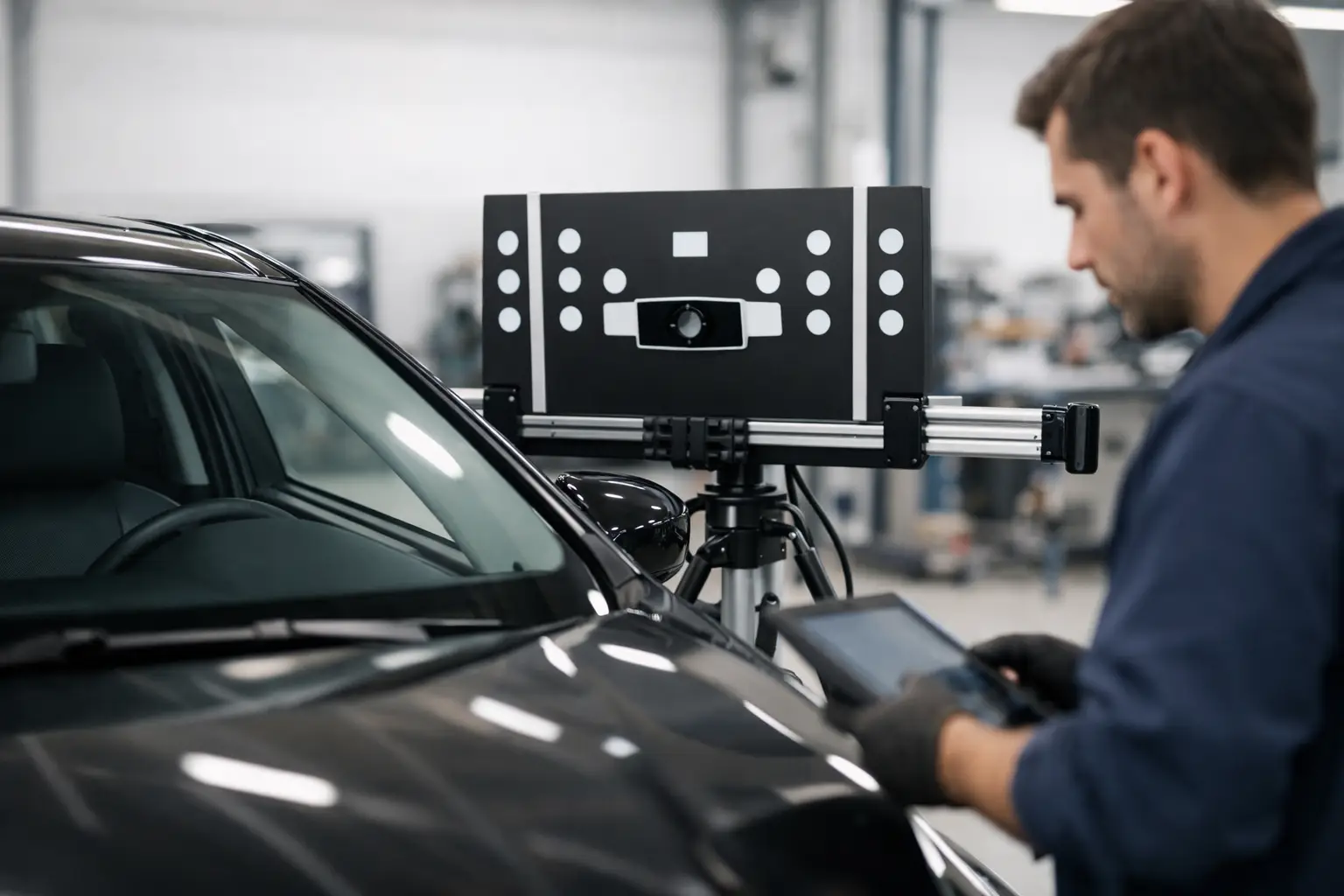
Once the adhesive has cured sufficiently and the vehicle is ready, the camera can be calibrated if the manufacturer procedure calls for it. This is normally done in one of two ways.
Static calibration
Static calibration is carried out in a controlled workshop setting. The vehicle is positioned on a level surface, with tyre pressures, steering position and vehicle height checked as required. Diagnostic equipment communicates with the vehicle while precisely placed targets are used to give the camera a fixed visual reference.
The setup is exacting. Target distance, height, alignment and lighting can all matter. A workshop cannot treat this as a quick scan-tool exercise. If the setup area or equipment is unsuitable, the result may not be reliable.
Dynamic calibration
Dynamic calibration is completed while the vehicle is driven under specified road conditions. The system learns its reference point by observing lane markings, road features and traffic conditions. The required speed, distance and route can vary by manufacturer.
Dynamic calibration may sound simpler, but it still needs the correct conditions. Heavy rain, poor lane markings, congestion, low light or unsuitable roads can prevent the procedure from completing. In Singapore, weather and traffic conditions can make this especially variable, so customers should be given realistic expectations rather than a promise based on best-case conditions.
Some vehicles require only one method; others require both. The vehicle manufacturer’s procedure determines the correct route.
What should be checked before the car is handed back
A proper handover is more than a clean windscreen and a working wiper. The workshop should verify that the camera cover and mirror-area trim are refitted neatly, the rain sensor operates correctly where fitted, and no relevant fault messages remain on the dashboard. It should also check for water ingress, wind noise risk, correct moulding fit and any disturbance to interior trim.
For a calibration-required vehicle, confirmation that the procedure has completed successfully should form part of the work record. If calibration cannot be completed on the day, the reason should be explained plainly and the next step agreed. It may be due to weather conditions, an unrelated fault code, a suspension or wheel-alignment issue, or a component that needs further attention.
A few dashboard warnings deserve prompt follow-up after replacement:
- Lane-keeping, collision-warning or camera-system alerts that remain illuminated.
- Driver-assistance features that are unavailable or switch off during normal driving.
- A rain-sensing wiper function that behaves inconsistently after refitting.
- New wind noise, water leaks or loose trim around the windscreen.
These symptoms do not automatically mean the windscreen itself is faulty. However, they should not be ignored or explained away as normal after a replacement.
Calibration is not a substitute for correct mechanical condition
Calibration works from the vehicle’s existing geometry. If the car has incorrect tyre pressures, uneven tyre wear, damaged suspension components, a bent wheel or poor wheel alignment, the ADAS system may still perform poorly even after a successful calibration.
This is why a specialist workshop should not make isolated promises. If an inspection suggests another issue is affecting the result, the customer needs direct, independent advice. The right repair may involve resolving that condition first, then completing the calibration. It is a more disciplined approach than forcing a pass through a procedure and hoping the system behaves as expected.
The same principle applies after collision repairs, suspension work or changes that alter ride height. A vehicle that has been lowered, fitted with non-standard wheels or repaired following impact may need additional checks. Calibration is precise, but it cannot correct physical misalignment elsewhere on the car.
Choosing a workshop for windscreen and ADAS work
Ask whether the workshop checks your vehicle’s specification before ordering glass, whether it can arrange or perform the required calibration, and how it verifies the final result. You should also ask how surrounding trim and roof-lining areas will be protected during removal. These questions are particularly worthwhile on cars with ageing interior materials, premium finishes or convertible-related trim that can be more sensitive to handling.
At 8 Cushion, windscreen-related work is approached with the same care given to interior restoration and trim replacement: assess the vehicle properly, define the scope clearly and maintain accountability for workmanship. No assumptions, no unnecessary middleman handling, and no vague answer when a safety system needs a specific procedure.
A windscreen replacement should restore more than your view of the road. When your vehicle relies on camera-based driver assistance, insist on a process that respects the glass, the technology and the condition of the car around it.
Related posts
Convertible Roof Repair vs Replacement
Convertible roof repair vs replacement explained clearly - when a repair is enou
Car Roof Liner Repair Guide for Lasting Results
A car roof liner repair guide for owners dealing with sagging fabric, adhesive f
Windscreen Replacement Service Explained
Need a windscreen replacement service? Learn what matters, how the job should be